

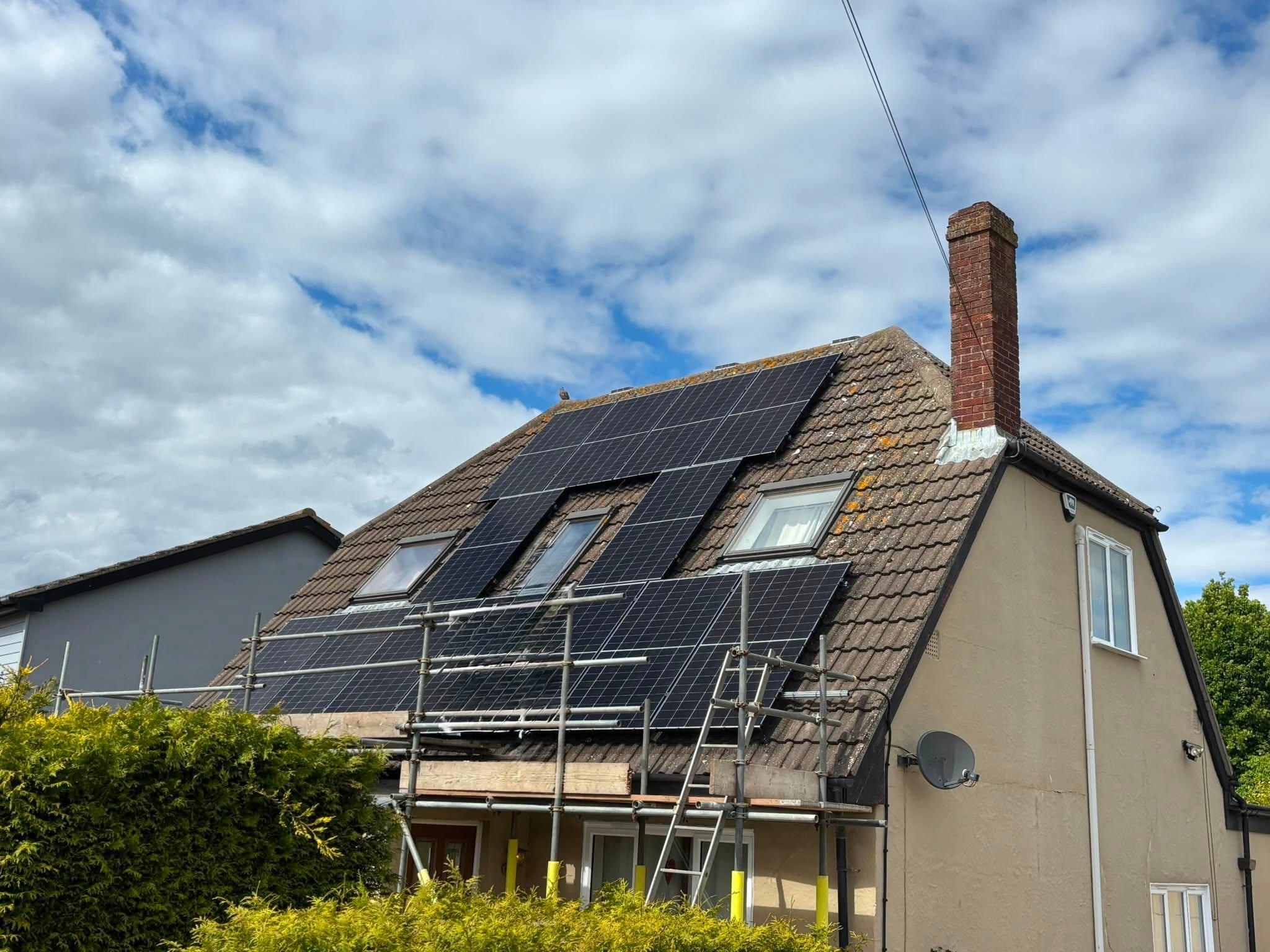
If you’re considering solar panels in Colchester or the surrounding area, one of the first questions you’re likely to ask is: what is the cost of solar panel installation?
The short answer is that there isn’t one fixed price. The cost of solar panel installation depends on the size of the system, the number and type of panels, whether battery storage is included, the property itself and how much electricity you use.
However, having some real figures makes the decision much easier.
Recent* Orton & Wenlock proposals provide two useful examples. A large domestic solar and battery system comprising 25 panels, an 11.125kW solar array and 10.36kWh of battery storage was quoted at £15,518. A much larger 57kW commercial solar and battery system for a site in Colchester was quoted at £37,140.
These aren’t standard package prices or a guarantee of what another property will cost. Every solar installation, whether a domestic solar panel installation or a commercial solar panel installation, needs to be designed around the individual property and its energy requirements. But they provide useful real-world examples of what different solar systems can cost, and, importantly, what that investment could deliver in return.
*These proposals are based on June 2026 figures. Prices may have changed since this blog was published.
How Much Does Solar Panel Installation Cost?
The solar panel system cost is determined by much more than the number of panels on the roof.
A complete solar panel installation can include solar panels, an inverter, mounting equipment, electrical components, monitoring, battery storage where required, system design, installation and commissioning.
The property itself also affects the final specification.
That’s why two homes with a similar number of bedrooms, or two commercial buildings with similar roof areas, won’t necessarily receive the same quotation.
At Orton & Wenlock, we design the system around the property’s energy consumption and how that energy is used. The objective isn’t simply to fit as many panels as possible. It is to design a system that delivers the right balance of generation, cost and long-term financial value.
A Real Domestic Solar Cost Example
To put the cost of solar panel installation into context, a recent Orton & Wenlock domestic proposal included:
- 25 × 445W solar panels
- 11.125kW total solar capacity
- 10.36kWh battery storage
- 10kW hybrid inverter
- Estimated annual solar generation of 10,299kWh
- Total system price: £15,518
This is a relatively substantial domestic solar and battery system, rather than a typical small household installation, so the £15,518 figure shouldn’t be treated as a standard price for every home.
What makes the example particularly useful is that we can look beyond the installation price.
The system was estimated to deliver £2,327 in first-year electricity bill savings, with the proposal modelling a payback period of 5 years and 11 months.
That illustrates an important point when comparing solar quotations: price alone doesn’t tell you whether a system represents good value.
The more useful questions are how much electricity it is expected to generate, how much of that electricity you can use yourself, how much it could reduce your electricity costs and how those savings compare with the initial investment.
A Real Commercial Solar Cost Example in Colchester
Commercial solar systems can be considerably larger, but businesses can also have much greater opportunities to reduce electricity costs.
A recent Orton & Wenlock proposal for a commercial site in Colchester included a 57kW solar PV system comprising 114 × 500W panels, together with battery storage.
The total quoted system price was £37,140.
The proposed system was estimated to generate 50,445kWh of electricity per year, based on annual site electricity consumption of 40,000kWh.
The financial modelling estimated:
System cost: £37,140
Estimated first-year electricity bill savings: £9,637
Modelled payback: 3 years, 7 months
This is a particularly useful example of why businesses shouldn’t judge a commercial solar project solely by its upfront cost.
Despite costing considerably more than the domestic example, the commercial system has a shorter modelled payback period because of the relationship between the site’s energy demand, solar generation, electricity usage and export income.
Actual savings and payback will always vary according to the site, system performance, energy usage and electricity tariffs, and projected performance should be treated as an estimate rather than a guarantee.
What Affects the Cost of Solar Panels in Colchester?
When comparing solar panels in Colchester, there are several factors that can increase or decrease the overall cost.
1. The Size of the Solar System
System size is one of the biggest influences on the solar panel system cost.
A larger system requires more panels, mounting equipment and associated electrical equipment. Depending on the design, it may also require different inverter capacity and additional installation work.
But bigger isn’t automatically better.
The right system should be designed around the property’s available space and electricity demand. Installing additional generation that offers little practical or financial benefit isn’t the objective.
2. Your Electricity Consumption
Your current electricity usage is fundamental to solar system design.
For homeowners, this means looking at annual electricity consumption and when energy tends to be used throughout the day.
For businesses, the consumption profile can be even more important.
Commercial properties with significant daytime electricity demand can be particularly well suited to solar because electricity is being consumed at the same time the panels are generating it.
The more solar electricity that can be used directly on-site, the less electricity needs to be purchased from the grid.
3. Roof Size, Orientation and Condition
Available roof space determines how many panels can potentially be installed, but size isn’t the only consideration.
The orientation, pitch, condition and layout of the roof all influence system design and potential generation.
Shading and obstructions also need to be considered, as does the practical installation process.
A straightforward installation on a large, accessible roof can have very different requirements from a property with several roof elevations or more complicated access.
These factors are why an accurate quotation requires a proper assessment rather than simply multiplying a standard cost by the number of panels.
How Much Does Battery Storage Add to Solar Costs?
Solar battery storage increases the upfront cost of solar panel installation, but the important question is whether it improves the financial performance of the overall system.
Without battery storage, solar electricity that isn’t being used at the time it is generated can be exported to the grid.
A battery allows some of that excess generation to be stored and used later.
For a homeowner who generates electricity during the day but consumes more in the evening, this can increase the amount of self-generated electricity used within the home.
For commercial properties, battery storage can also be considered where the site’s consumption profile makes storing and shifting energy financially worthwhile.
The effect can be significant.
In the 57kW Colchester proposal, estimated solar PV self-consumption was 15,769kWh without energy storage. With the proposed storage system, estimated PV self-consumption increased to 27,609kWh.
However, a battery shouldn’t automatically be added to every installation.
It needs to be correctly sized and assessed alongside generation and consumption. Orton & Wenlock therefore designs solar battery storage as part of the overall energy system rather than treating it simply as an optional extra. This approach is also reflected in our dedicated battery storage guidance.
Is Domestic Solar Cheaper Than Commercial Solar?
In terms of total installation price, usually; but comparing the headline figures alone can be misleading.
Domestic systems tend to be smaller because household electricity consumption and available roof area are generally lower.
Commercial installations can range from relatively modest systems to much larger projects covering extensive roof areas.
The cost of solar panel installation for a business can be influenced by:
- Total system capacity
- Available roof or ground space
- Electricity consumption
- Site access
- Electrical infrastructure
- Installation complexity
- Battery storage requirements
- The scale and design of the project
Commercial solar can nevertheless offer a particularly strong financial case where a business consumes significant amounts of electricity during daylight hours.
That is why Orton & Wenlock assesses commercial solar around the site’s actual operational and energy profile rather than simply recommending a system based on available roof space.
Should You Compare Solar Installers on Price Alone?
No.
Understanding the cost of solar panel installation is important, but the cheapest quotation isn’t necessarily the one that will produce the best financial result.
When comparing quotations, look beyond the headline installation price and consider:
- The proposed system capacity
- Panel and inverter specification
- Expected annual generation
- Battery capacity, if included
- Expected self-consumption
- Estimated electricity bill savings
- Expected payback
- Product and performance warranties
- Installation quality
- The assumptions used to calculate savings
A lower-cost system that generates less electricity or isn’t properly matched to the property’s consumption could ultimately provide poorer value.
Likewise, spending more on a larger system doesn’t automatically mean a better return.
The aim should be to find the system that makes financial and technical sense for the property.
How Long Does It Take for Solar Panels to Pay for Themselves?
There isn’t a single payback period that applies to every solar installation.
Payback is essentially the point at which the financial benefit generated by the system has recovered the original investment.
It is affected by the system cost, electricity generation, how much solar energy is used on-site, electricity tariffs, export payments and changes in energy costs over time.
Our two recent proposals demonstrate how different the result can be.
The £15,518 domestic solar and battery system was modelled with a payback of 5 years and 11 months.
The £37,140 commercial system in Colchester was modelled with a payback of 3 years and 7 months.
So the more expensive system actually had the shorter projected payback.
That’s why we believe the better question isn’t simply “How much does solar cost?”
It’s:
“What is the cost of solar panel installation, what is it expected to save me, and how long could it take to recover that investment?”
Those are the figures that allow a homeowner or business to make a properly informed decision.
How Are Solar Savings Calculated?
Any credible estimate should consider both sides of the equation: how much electricity the system is expected to generate and how the property actually consumes electricity.
For example, the commercial Colchester proposal was based on estimated annual solar generation of 50,445kWh and assumed annual electricity consumption of 40,000kWh. Its financial calculations also incorporated imported electricity, exported electricity and export credit.
Those calculations inevitably depend on assumptions.
Solar generation varies, electricity usage can change and future tariffs aren’t known with certainty. The proposal itself therefore makes clear that estimated system performance is guidance rather than a performance guarantee.
That’s an important distinction.
A good solar quotation should give you a realistic basis for assessing the investment without presenting forecasts as guaranteed future savings.
Is the Cost of Solar Panel Installation Worth It?
That depends on the individual property and the system being proposed.
Solar is most compelling when the system is correctly sized, the property has suitable installation space and a meaningful proportion of the electricity generated can be used to reduce electricity purchased from the grid.
For homeowners, that can mean lower household electricity bills, set every 3 months by Ofgem, and greater control over long-term energy costs.
For businesses, the potential impact can be larger. Reducing the amount of electricity purchased from the grid can lower an ongoing operating expense, particularly where there is substantial daytime consumption.
The two proposals above demonstrate why we assess cost and return together.
An installation shouldn’t be judged simply by whether £15,000, £20,000 or £40,000 sounds expensive. The investment needs to be assessed against what the system is designed to generate and the financial benefit it is expected to produce.
So, What is the Cost of Solar Panel Installation in Colchester?
There isn’t a single price that applies to every home or business.
Based on recent Orton & Wenlock proposals, we can give two real examples:
Large domestic solar + battery example
11.125kW solar system + 10.36kWh battery
£15,518 quoted system price
£2,327 estimated first-year bill savings
5 years 11 months modelled payback
Commercial Colchester solar + battery example
57kW solar system + battery storage
£37,140 quoted system price
£9,637 estimated first-year bill savings
3 years 7 months modelled payback
These examples shouldn’t be treated as fixed prices. A smaller domestic system may require a very different investment, while a larger commercial project could cost substantially more.
But they demonstrate the relationship that matters:
System cost → solar generation → electricity savings → payback → long-term return.
That’s a much more useful way to assess solar than looking at the cost of solar panel installation in isolation.
Get an Accurate Solar Installation Cost for Your Property
If you’re researching solar panels in Colchester and want to understand the likely cost of solar panel installation for your home or business, the next step is to assess your property and electricity usage.
At Orton & Wenlock, we design solar systems around the property, available space, energy consumption and long-term financial objectives.
Your proposal can then give you a clear view of the recommended system, cost of solar panel installation, estimated generation and expected savings, allowing you to decide whether the investment makes sense for you.
Request a solar quote from Orton & Wenlock
FAQs
What is the average cost of solar panel installation?
There isn’t one price that accurately represents every installation because system size, property requirements, battery storage and energy consumption vary considerably. A recent large Orton & Wenlock domestic solar and battery proposal was £15,518, while a 57kW commercial solar and battery proposal in Colchester was £37,140. These are real examples rather than standard package prices.
What affects the cost of solar panel installation?
The main factors include system capacity, number of panels, battery storage, inverter requirements, roof size and layout, site access, electricity consumption and overall installation complexity.
Does adding a solar battery increase the cost?
Yes. Battery storage adds equipment and installation cost. However, it can allow more of the electricity generated by the solar panels to be used on-site rather than exported, so its value should be assessed against the property’s energy usage rather than cost alone.
How long does it take for solar panels to pay for themselves?
It varies considerably. In two recent Orton & Wenlock proposals, the modelled payback periods were 5 years 11 months for a large domestic solar and battery system and 3 years 7 months for a commercial system in Colchester. These are project-specific estimates, not guaranteed or universal payback periods.
Are commercial solar panels more expensive?
Commercial systems are generally larger, so the total project cost can be higher. However, businesses with substantial daytime electricity consumption can potentially use a high proportion of the electricity generated, which can strengthen the financial case for commercial solar.
Can I get an exact solar price without a survey?
A rough indication may be possible, but an accurate quotation requires enough information to properly specify the system. Roof or site characteristics, energy consumption, system size and battery requirements can all affect the final price.
Is the cheapest solar quote the best value?
Not necessarily. Compare system capacity, expected generation, equipment, warranties, estimated savings and the assumptions behind the financial projections as well as the installation price. The objective is a system that performs well and provides strong long-term value, not simply the lowest upfront quotation.