

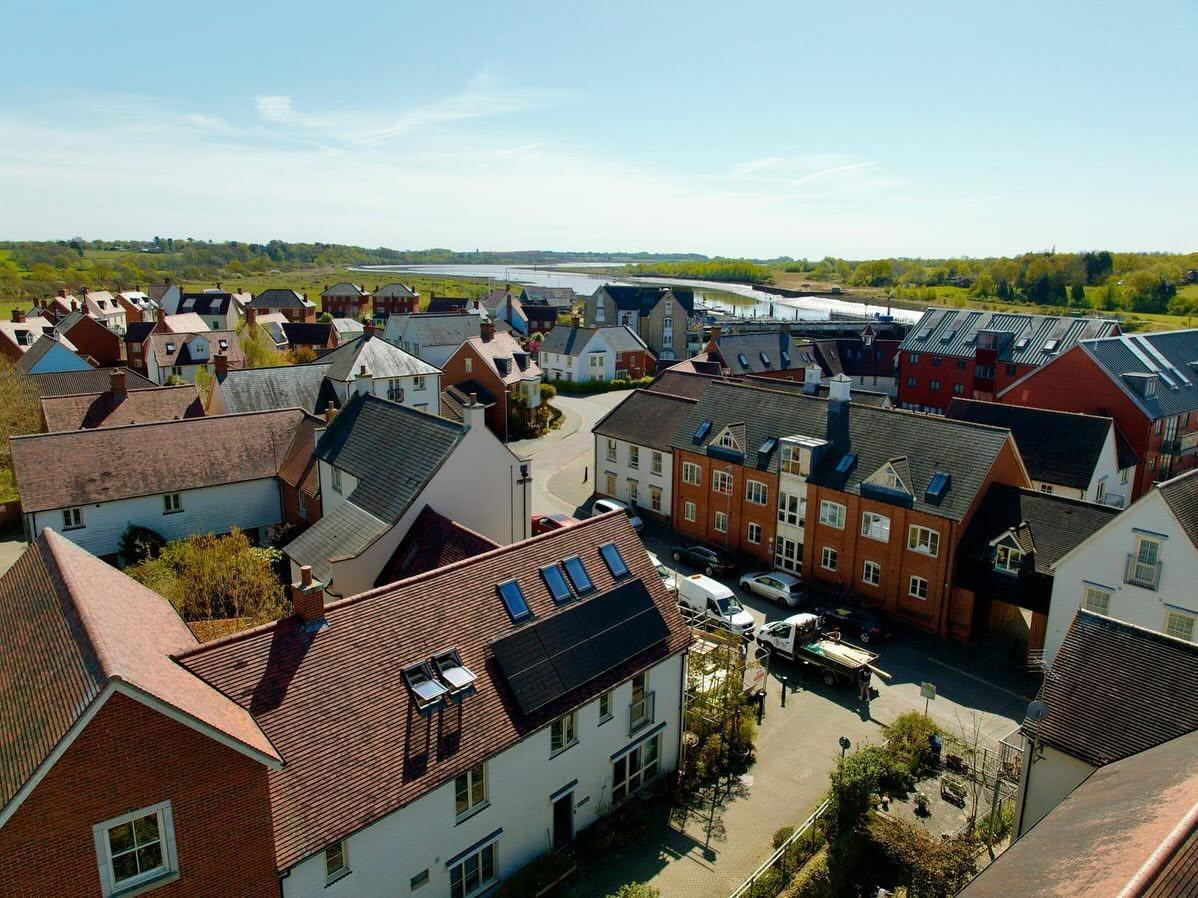
Choosing the best solar panel installers in Colchester for you is one of the most important decisions you will make when investing in solar.
The panels themselves matter, but the quality of the system ultimately depends on much more than the equipment fitted to your roof. The survey, system design, installation quality, electrical work, battery specification, project management and aftercare all affect how well the system performs over the long term.
That is why comparing solar panel installers in Colchester should involve more than simply requesting several prices and choosing the cheapest quotation.
A well-designed solar system should be built around your property, electricity consumption and long-term objectives. For a homeowner, that may mean reducing household electricity bills and increasing the amount of solar energy used at home. For a business, it could mean reducing operating costs, improving energy efficiency and achieving a clear financial return on the investment.
So, what should you actually look for when choosing between solar installers in Colchester?
1. Check Certifications and Accreditations
The first step when comparing solar panel installers is checking whether the company has the appropriate certifications and credentials for the work it is carrying out.
For solar PV installations, MCS certification (which we hold) is one of the most important things to look for.
MCS sets standards covering the design and installation of small-scale renewable energy systems in the UK. Using an appropriately certified installer provides reassurance that the company is working to recognised technical and quality standards.
Certification should not be viewed as the only reason to choose one company over another, but it is an important starting point.
You should also ask an installer which other relevant accreditations, consumer protection schemes and electrical qualifications apply to the work they are proposing.
Reputable solar panel installers in Colchester should be comfortable explaining their credentials and what those accreditations mean for you as a customer.
2. Look at Experience, Not Just Years in Business
Experience matters, but the number of years a company has existed does not tell you everything.
The more useful question is whether the installer has experience delivering the type and scale of solar installation you are considering.
A homeowner may want to see examples of similar domestic solar installations, particularly where battery storage, EV charging or more complex roof layouts are involved.
Businesses should go further.
Commercial solar installations can involve larger systems, more complicated electrical infrastructure, working-at-height requirements, health and safety considerations, grid connection requirements and installation around ongoing business operations.
If you are responsible for a warehouse, industrial unit, farm, school, office or other commercial property, ask whether the installer can demonstrate experience managing comparable projects.
At Orton & Wenlock, our history stretches back to 1925, with the business developing significant electrical expertise before moving into renewable energy and solar. Today, that experience is applied to solar installations for domestic and commercial properties across Essex.
3. Understand How the Project Will Be Managed
Good project management becomes increasingly important as the size and complexity of a solar panel installation increases.
A professional solar installation service in Colchester should provide a clear process from the initial enquiry through to system commissioning and handover.
That should normally include:
- Initial consultation
- Assessment of electricity usage
- Site or property survey
- System design
- Quotation and performance estimates
- Installation planning
- Installation
- Electrical testing and commissioning
- System handover
- Monitoring and aftercare
For commercial projects, you should also understand who will manage the installation.
Ask whether there will be a dedicated project manager or a clear point of contact, how the installer plans to minimise disruption to the site and how health and safety requirements will be managed.
At Orton & Wenlock, commercial projects are managed end-to-end, with a dedicated project manager overseeing survey, design, installation and delivery.
That gives the customer a clear point of contact while helping maintain control over programme, communication and installation quality.
4. Pay Close Attention to System Design Quality
One of the biggest differences between solar quotations can be hidden in the system design.
It is relatively easy to compare the number of panels or the total quotation price.
It is much harder to determine whether the proposed system has actually been designed properly for your property.
Good solar design should consider factors including:
- Your annual electricity consumption
- When electricity is used during the day
- Available roof or ground space
- Roof orientation and pitch
- Shading
- Panel specification
- Inverter capacity
- Expected annual generation
- Expected self-consumption
- Battery requirements
- Export assumptions
- Future electricity requirements
Simply fitting the maximum possible number of panels is not always the best approach.
The objective should be to create a system that makes technical and financial sense.
For a household, that could mean balancing generation with daytime and evening electricity usage.
For a business, the electricity consumption profile can be even more important. Sites with substantial daytime demand can often use a high proportion of their solar generation directly, potentially strengthening the financial case considerably.
A good installer should therefore be able to explain not only what they are proposing, but why they have designed the system that way.
If two quotations recommend very different system sizes for the same property, ask both installers to explain the assumptions behind their designs.
5. Compare Performance, Not Just Installation Price
Price obviously matters, but it should not be considered in isolation.
When comparing solar panel installers in Colchester, homeowners and businesses may find quotations with significantly different headline costs.
The cheapest system does not automatically represent the best value.
Compare:
- Total system capacity
- Panel specification
- Inverter specification
- Expected annual generation
- Battery capacity where applicable
- Expected solar self-consumption
- Estimated electricity savings
- Projected payback
- Equipment warranties
- Workmanship protection
- Installation quality
- The assumptions behind any financial projections
For more detail on what affects solar pricing locally, see our guide to the cost of solar panel installation in Colchester.
The important relationship is not simply:
Installation price
It is:
System cost → generation → electricity savings → payback → long-term return
A more expensive system can sometimes produce the stronger financial result if it is better designed around the property’s electricity consumption.
Equally, installing a larger system than the property can use effectively does not automatically improve the return.
If you’re considering solar for your home, our guide to ‘Are home solar panels worth it in Essex’ explains the wider financial case, including savings, payback and the factors that affect whether solar represents good value.
6. Ask How Battery Storage Has Been Assessed
Battery storage has become an important consideration for many solar installations, but it should not simply be added to every quotation as a standard extra.
The right question is whether a battery improves the performance and financial value of your particular system.
Solar battery storage allows excess electricity generated during the day to be stored and used later rather than immediately exported to the grid.
For homeowners, a battery can be particularly useful where much of the household’s electricity consumption occurs in the evening.
For businesses, storage can help increase solar self-consumption and, depending on the site’s electricity profile and tariff structure, potentially reduce the amount of electricity imported during more expensive periods.
However, battery size matters.
An oversized battery can add unnecessary cost. An undersized system may not make the best use of available surplus generation.
When comparing Colchester solar panels and battery proposals, ask the installer:
* Why has this battery capacity been recommended?
* How much solar energy is expected to be stored?
* How often is the battery expected to cycle?
* What effect does it have on projected self-consumption?
* How does it affect projected savings and payback?
* Can the battery system be expanded in future?
All reputable solar panel installers in Colchester should be able to justify the recommendation using your likely generation and electricity usage rather than simply presenting battery storage as an automatic upgrade.
7. Understand Exactly What the Warranties Cover
A solar installation can contain several different warranties, and they should not all be treated as the same thing.
Depending on the system, these may include:
Solar panel product warranty
This relates to defects or manufacturing issues with the physical panel.
Solar panel performance warranty
This relates to the manufacturer’s stated level of panel performance over a defined period.
Inverter warranty
The inverter will normally have its own manufacturer warranty.
Battery warranty
Battery storage usually carries a separate warranty, potentially including terms relating to years of operation, usage or cycles.
Workmanship warranty
This relates to the installation work itself rather than the equipment manufacturers.
Ask solar panel installers in Colchester to explain each warranty clearly before committing.
You should understand:
- How long each warranty lasts
- Who provides it
- What is and is not covered
- What happens if equipment develops a fault
- Who you contact if there is a problem
- Whether warranties require any maintenance or monitoring conditions to be met
Long warranty periods look attractive on paper, but the detail behind them matters.
8. Look for Evidence of Previous Work
Before choosing between solar panel installers in Colchester, look at what they have actually delivered.
Case studies can tell you considerably more than generic claims about service or quality.
Useful solar case studies should ideally explain:
- The type of property or business
- The customer’s energy requirements
- The system size
- Equipment installed
- Why that system was selected
- Expected generation
- Expected savings or financial outcome where appropriate
For commercial solar in particular, look for evidence that the installer understands different operational environments rather than simply installing the same system repeatedly.
Warehouses, farms, offices, schools and industrial properties can have very different energy profiles and project requirements.
Customer reviews are also useful for understanding the experience surrounding the installation itself, including communication, reliability, workmanship and aftercare.
9. Make Sure the Installer Can Explain the Numbers
Solar quotations frequently contain estimates for generation, electricity savings and payback.
These figures can be valuable, but they are still projections.
Trustworthy solar panel installers in Colchester should be prepared to explain how they have been calculated and which assumptions have been used.
Ask about:
- Estimated annual generation
- Your assumed electricity consumption
- How much generated electricity is expected to be used on-site
- Electricity import prices used in the calculation
- Export tariff assumptions
- Whether future energy price increases have been assumed
- Expected battery performance
- Projected payback
No installer can guarantee exactly how much electricity a solar system will generate or precisely what electricity prices will be many years into the future.
The aim should be a realistic, clearly explained financial assessment that helps you make an informed decision.
Questions to Ask Solar Panel Installers in Colchester
Before accepting a quotation, it is worth asking solar panel installers in Colchester the same core questions.
This makes comparing proposals much easier.
Consider asking:
1. Are you MCS certified for the proposed installation?
2. Who will actually carry out the installation?
3. Do you use your own installation teams or subcontract the work?
4. Who will manage my project from start to finish?
5. How have you calculated the recommended system size?
6. What annual solar generation do you expect?
7. What assumptions have been used to calculate my savings?
8. Why have you recommended this particular panel and inverter?
9. If a battery is included, why has that capacity been selected?
10. What warranties apply to the panels, inverter, battery and workmanship?
11. What happens if there is a problem after installation?
12. Can you show me examples of similar projects you have completed?
13. What monitoring will I have once the system is running?
14. Are there any additional costs that are not included in the quotation?
15. How long do you expect the installation to take?
The quality of the answers can be just as revealing as the quotation itself.
Good solar panel installers in Colchester should be able to explain the proposal clearly without relying on excessive technical terminology or putting pressure on you to make an immediate decision.
Choosing Between Solar Panel Installers in Colchester
There are several factors to consider when choosing solar panel installers in Colchester, but the underlying principle is straightforward.
You are not simply buying solar panels.
You are investing in a complete energy system that needs to be correctly assessed, designed, installed and supported.
The strongest solar panel installers in Colchester should therefore be able to demonstrate:
- Appropriate certification and accreditation
- Relevant installation experience
- Strong project management
- Site-specific system design
- Clear performance calculations
- Appropriate battery specification
- Transparent warranties
- Evidence of previous projects
- Reliable aftercare
Price remains part of the decision, but it should be considered alongside the quality and expected performance of the complete system.
At Orton & Wenlock, every solar installation is designed around the property, electricity usage and long-term financial objectives of the customer.
Whether you are considering solar for your home or evaluating a larger commercial installation, our aim is to provide a clear recommendation based on what the system is expected to deliver rather than simply how many panels can fit on the roof. This is why we are proud to be one of the most trusted and reputable solar panel installers in Colchester.
Speak to a Solar Installer in Colchester
If you are researching solar panel installers in Colchester, Orton & Wenlock can assess your property or site and provide a system recommendation based on your actual energy requirements.
We manage the process from initial enquiry and survey through to system design, installation, commissioning and aftercare.
Your proposal will give you a clear view of the recommended system, expected generation, equipment specification and projected financial performance so you can assess the investment properly before making a decision.
Request a solar quote from trusted solar panel installers in Colchester, Orton & Wenlock today.